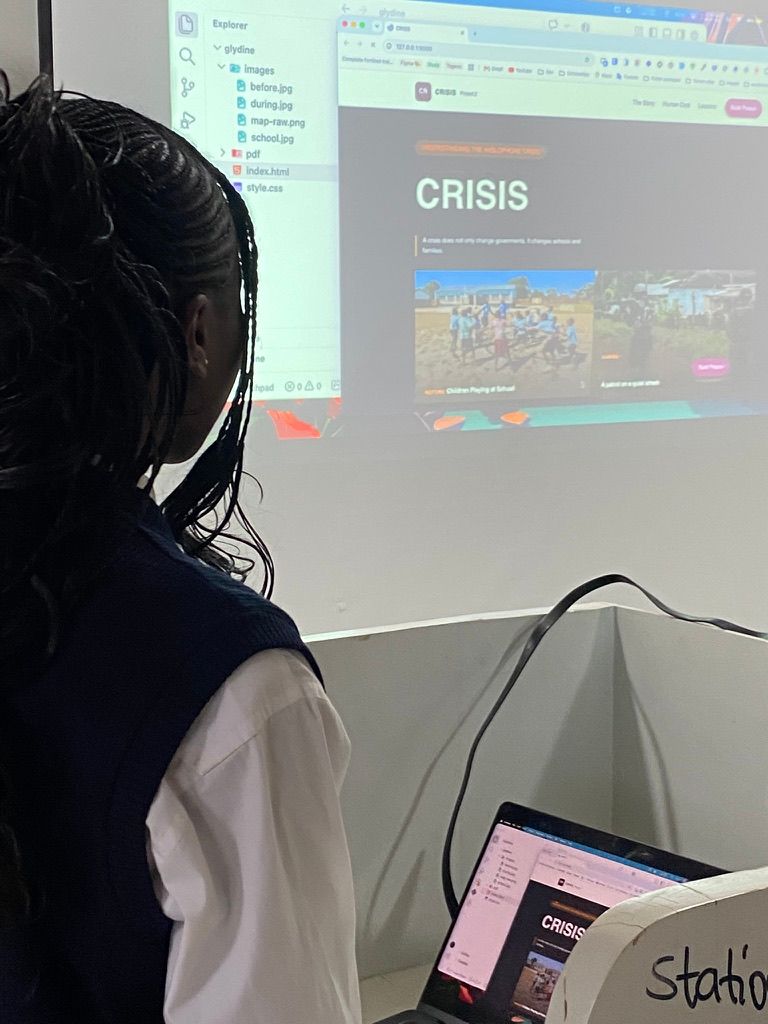

Ghokenyu Glydine Vuyof arrived at the Togeva STEAM Summer School this year to learn the fundamentals — what a loop is, what a tag is. Five weeks later she had published a website about the Anglophone Crisis: its history, its human cost, and what a better future might look like, with every factual claim on the page carrying its source.
It is called CRISIS, it is live on the internet, and its source code is open for anyone to read. She built it by hand.
We are proud of her. This post is about what she made, and why it matters.
What she built
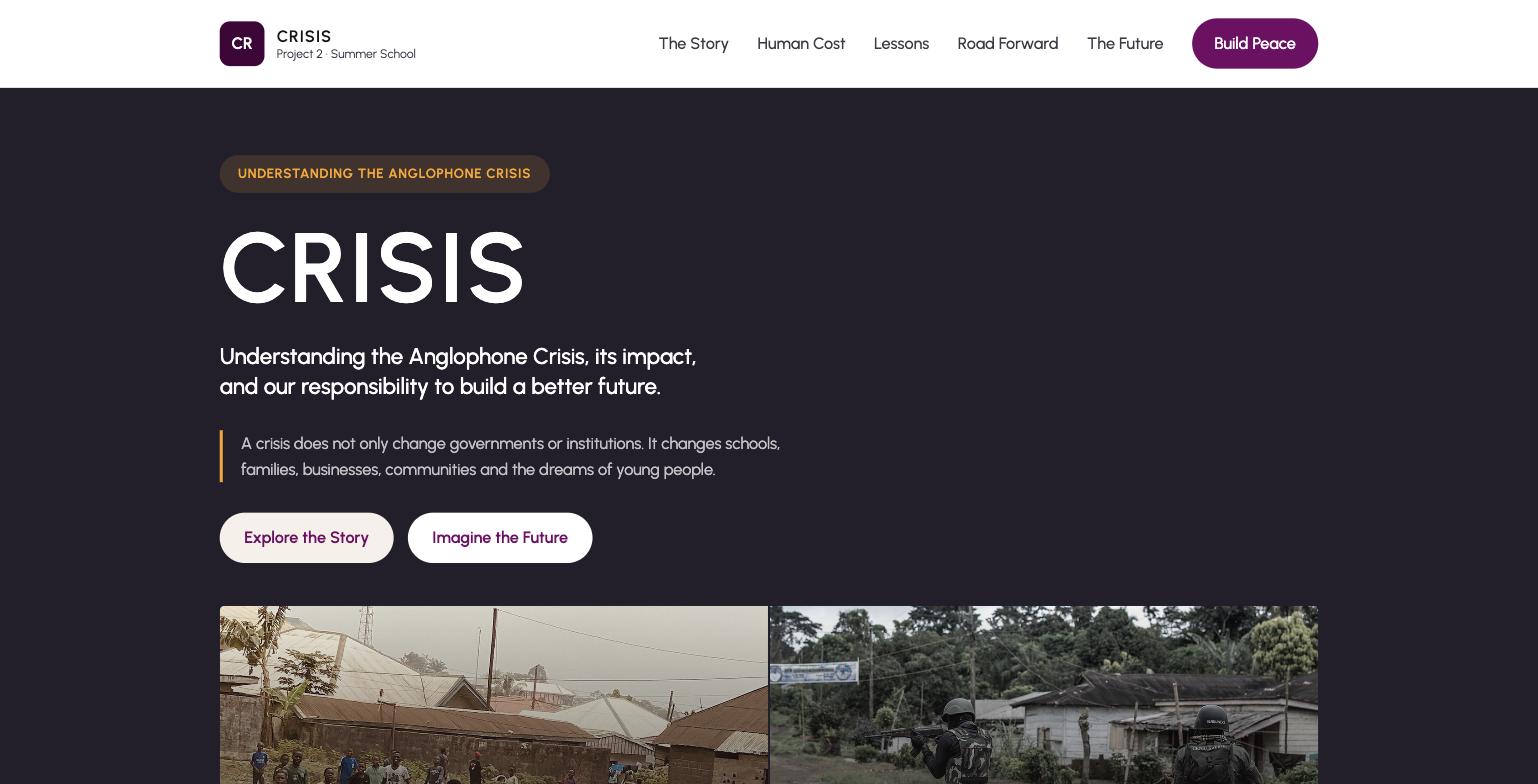
CRISIS is a long-form explainer, structured in six parts: what a crisis is, where this one is happening, how it began, what it costs ordinary people, what can be learned from it, and what a road forward could look like.
It is typed by hand in HTML and CSS, laid out entirely with flexbox. No framework. No template. No build step. For a student five weeks into learning what a tag is, that is not a small thing.
But the more striking decision is an editorial one. Early on the page, she writes that the project is about understanding what happened and how it affects everyday life — not about arguing over who is right. Every claim she makes carries a citation: Human Rights Watch, the United Nations in Cameroon. She built a page about the most divisive subject in her own region and refused to use it to score a point.
That is a discipline plenty of adults writing about this conflict have not managed.
Why she built it
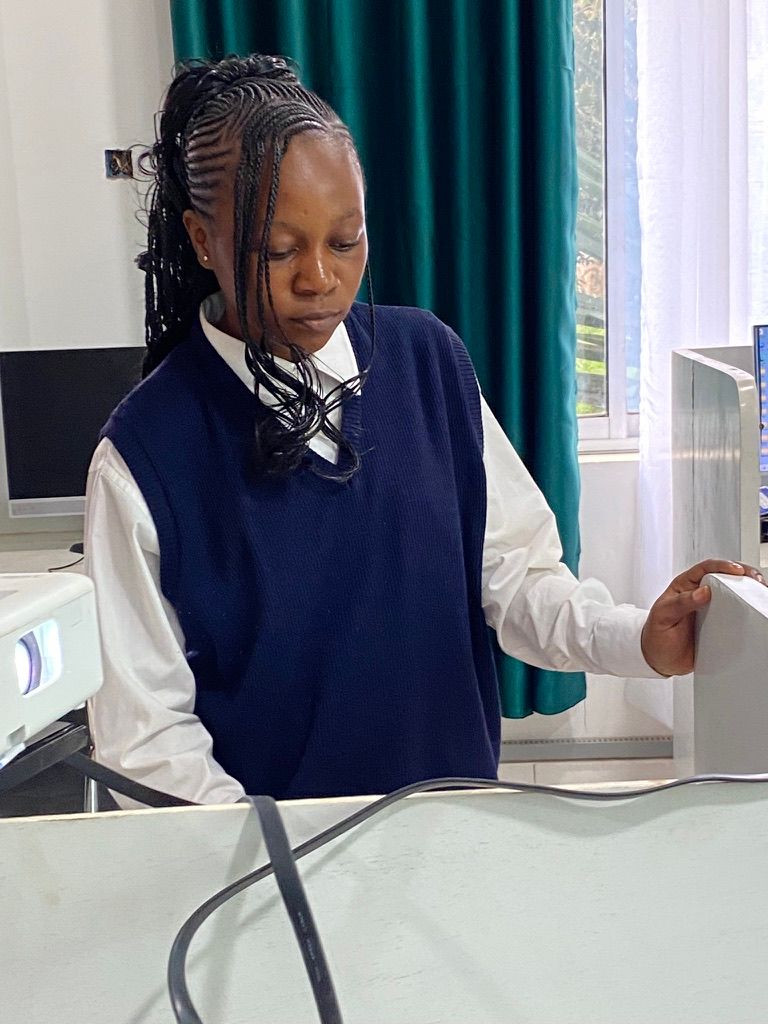
The project came from her own life.
Glydine sat her GCE A Levels while the crisis was going on around her. Preparing for the most consequential exams of her school career, under those conditions, was hard in ways that are difficult to convey to anyone who has not done it. She passed. And when she was given five weeks and a blank text editor, what she chose to build was an explanation — because she wants the world to know what is happening here, and what it has cost students like her.
She did not ask for a platform. She was given some HTML and she made one.
What the crisis has done to school in the North-West and South-West
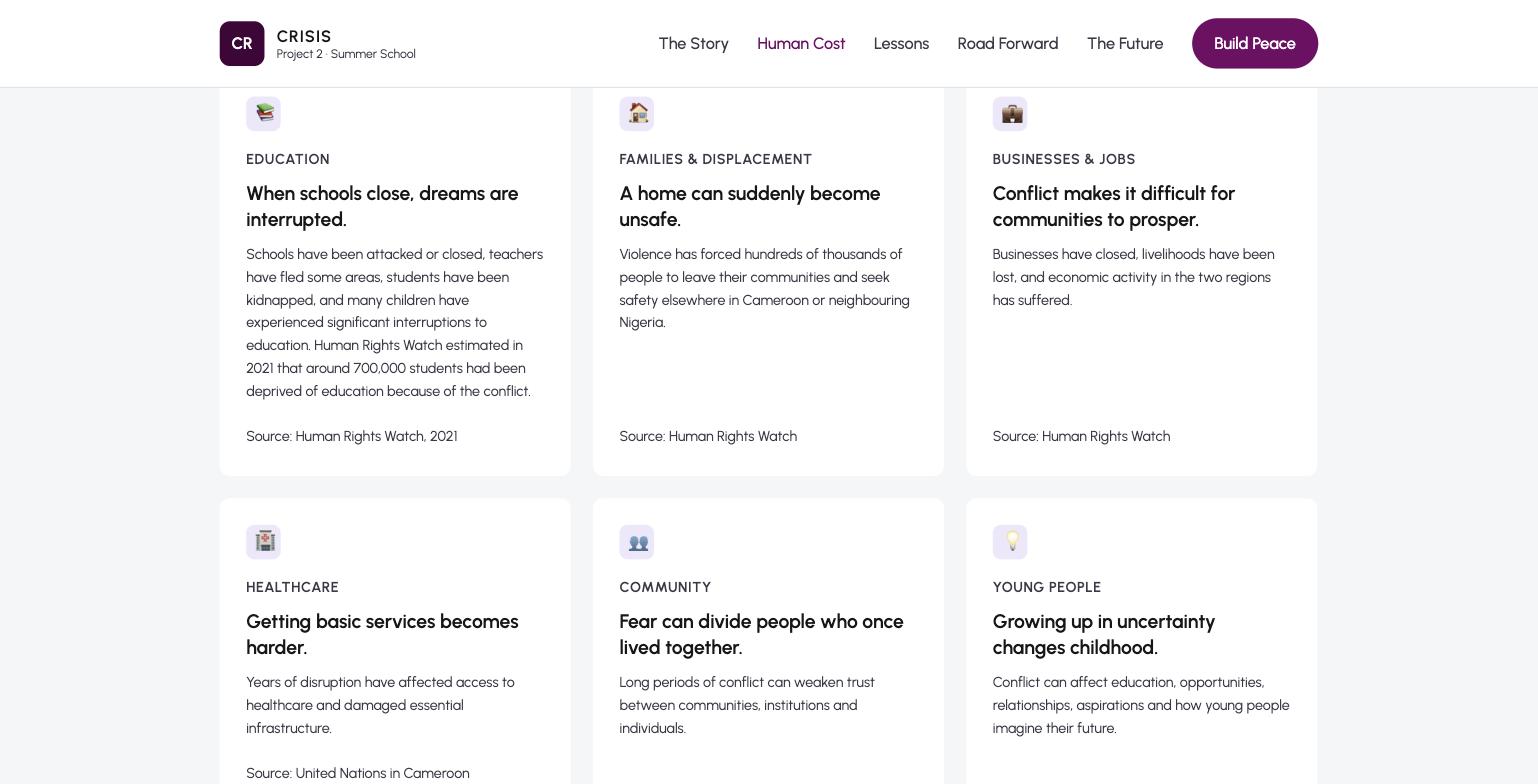
Cameroon has ten regions. Two of them — the North-West and the South-West — are predominantly English-speaking. Bamenda and Buea are their regional capitals. Since 2016, when teachers and lawyers first raised concerns about the Anglophone education and legal systems, and especially since the escalation into armed conflict after 2017, these two regions have carried something the other eight have not.
The effect on education is the part that is measurable, and it is severe.
At the start of the 2019/20 school year, 90% of public primary schools across the two regions were closed, affecting more than 850,000 children (UNESCO Global Education Monitoring Report ). Pre-primary enrolment collapsed over the same period — from roughly 50% in 2015/16 to 6% in the North-West and 19% in the South-West. Human Rights Watch estimated in 2021 that around 700,000 students had been deprived of education by the conflict — the figure Glydine cites on her own page. UNICEF put the number of children out of school in the Anglophone regions at nearly 500,000 in 2024 (Al Jazeera ).
Enrolment has been trending upward again in recent years, but as of 2024 it had not returned to pre-conflict levels.
Numbers describe the scale. They do not describe the texture. The texture is this: schools attacked, occupied or shut; teachers who left and did not come back; students taken; Monday lockdowns that still empty the streets of Bamenda and Buea week after week, so a school year loses a day of teaching every seven whether or not anything else goes wrong. A 2023 study found the conflict produced measurable declines in reading and mathematics scores and higher teacher absenteeism — which is the statistical shadow of a much simpler fact. Children cannot learn in a building nobody can safely reach.
And beyond the classroom: hundreds of thousands displaced from their communities, businesses closed, healthcare harder to reach, and trust between neighbours worn down by years of it.
This is the environment in which an A Level candidate sat down to revise.
Why this project matters
There is a version of this story where the point is simply that a student learned to code. That version undersells it.
What Glydine did was take the thing that has shaped her education more than any curriculum, and turn it into something she could hand to other people. That is a specific and difficult move. It requires understanding the subject well enough to explain it, finding sources rather than repeating what everyone around you says, and deciding what kind of account you want to give.
Three things make her project worth paying attention to:
It is sourced. Every factual claim carries an attribution. Teaching a teenager to cite is teaching them to think — and it means the page can be checked rather than simply believed.
It refuses to take a side. In a conflict where most accounts are advocacy, she wrote an explainer. That choice makes it usable by people who disagree with each other, which is the only kind of document that helps.
It ends by looking forward. The last sections are not about blame. They are about what protection, dialogue, rebuilding and reconciliation would actually require, and they close on a question she puts to her own generation: we may not have started the crisis, but we will inherit the Cameroon that comes after it.
Young people are usually written about in this conflict. Here, one of them did the writing.
Five weeks
Glydine's certificate lists what those five weeks covered: CS fundamentals, algorithms, introduction to programming, programming with Scratch, and introduction to web development. Hands-on projects, mentorship and teamwork.
She started with Scratch, like everyone else in her track. She finished with a published website carrying research she had done herself.
CRISIS was one of three sites shipped by the web development track this summer, alongside a personal portfolio and a fourteen-section explainer on artificial intelligence. All three are open source at github.com/togevacm .
What comes next
Glydine has passed her A Levels and is heading to university this year.
During our orientation programme, she told us what she wants to become: a surgeon. Not a vague interest in medicine — a specific ambition, named out loud.
That is exactly the kind of thing Togeva exists to hear and then act on. Our orientation programme is built on the belief that a young person who can name what they want has already done the hardest part, and that what they need next is someone to help them find the path. In our own way, we intend to keep supporting Glydine towards it.
There is a neat symmetry here that we did not plan. Her project argues that education must be protected, because children should not lose their future because adults disagree. She then went out and secured her own — through a crisis, on her own terms, and she is now on her way to a career built entirely around repairing people.
Ghokenyu Glydine Vuyof — we are proud of you.
Read her project: CRISIS — Understanding the Anglophone Crisis · Source code